

The Plight of Gulls

Updated: Aug 31
By Shona Spray

Image 1 - a European herring gull chick by Denitsa Kireva
In a blog written by RSPCA Wildlife Champion, Geoff Edmond stated, “We receive a report about deliberate or extreme cruelty to a gull every three days and last year alone we had nearly 4,000 reports about gulls in need.”
“During my time as an RSPCA inspector, who specialised in wildlife, I have seen gulls kicked, shot with air guns and catapults, stamped on. I have seen first-hand the suffering these amazing, beautiful birds are subjected to. And I just can’t understand it,” said Edmond.
Yet, you have seen “seagull attack” articles on the news hundreds of times. If you look up this phrase on a search engine, at least 15 news articles pop up, all detailing an occasion where a bloodthirsty seagull viciously attacked an unsuspecting civilian, or how flocks of seagulls launch coordinated attacks on children. Articles about attacks on gulls, however, are less common, despite attacks becoming more frequent.
Conservation Status of UK Gulls
Gulls are misunderstood birds. The common name “seagull” has all species of gull lumped together into one identifier which has become negatively associated with the gull family. There are 50 species of gull in the world (3).
Gulls most commonly encountered in the UK are the Black-headed Gull (Chroicocephalus ridibundus), Herring Gull (Larus argentatus), Great Black-backed Gull (Larus marinus), Lesser Black-backed Gull (Larus fuscus), Common Gull (Larus canus), and Kittiwake (Rissa tridactyla).
Despite their adaptability to urban habitats, all six species commonly found breeding in the UK are considered of conservation concern (1,3). On the Birds of Conservation Concern (BoCC) 5 list, Herring gulls, Common Gulls, Great Black-Backed Gulls and Kittiwake are now Red-Listed, and the Black-headed Gull and Lesser Black-backed Gull are Amber-listed (1).
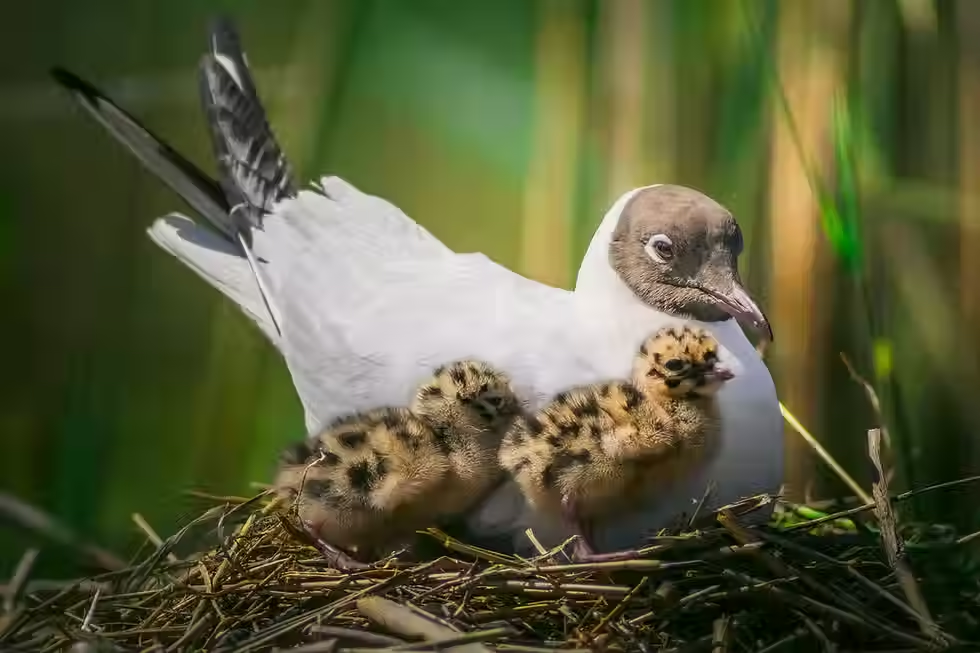
Image 2 - a black-headed gull and chicks by Daniil Komov
Urban Gulls
Gulls are traditionally considered to breed around the coasts and isles of Britain, predating fish, crabs, insects and small mammals (4). However, they are leaving coastal areas as humans have made survival in their natural habitats challenging.
Commercial fishing has reduced their available food, climate change has increased coastal storms making nesting sites less secure and rising sea temperatures have changed where fish are found.
However, gulls are omnivorous and the continuing expansion of towns into their natural habitats has further driven these intelligent birds to adapt to urban life (2,4).
They take advantage of human food waste and fishery discards with nesting sites being found on man-made structures such as rooftops and chimneys (2,3,5). These provide stable, predator-free habitats for them to raise their young.
“Like so many creatures who are seen as ‘pests’ - rats, foxes, pigeons, gulls - we have built on their homes,” Edmond explained. “We have cut off their food supplies and made life a lot more dangerous for them, whether it’s dropping litter, heavy traffic, or cutting down the nature that gives them protection.”

Image 3 - a European herring gull by Mauro Foassati
How Intelligent Are Gulls?
It is likely that gull adaptability is facilitated by the possession of a large brain and high cognitive abilities (2). Several studies have reported on their abilities; learning through observation, identifying gull individuals (adults, chicks, and family members), and the use of human prompts for foraging (2,6). They are even capable of using tools and completing small puzzles (2,6).
“Gulls form lifelong bonds with their partners, they are attentive parents, with both mum and dad taking time to incubate their eggs,” Edmond said. “They are intelligent, and are great at solving problems. Their chicks love to play and learn - just like children. They are brilliant birds. Yet they are one of the most persecuted wild birds in this country.”
The flexibility in habitat choice and foraging capabilities could also be explained by their high intelligence (2). In some gull populations, successful breeding sites in urban areas and an abundance of human resources has triggered a spike in population size across mainland Britain (2).
The population boom in cities and towns has created the illusion that gulls have become overpopulated (2,3,4). However, there has in fact been a drop in their breeding populations (1,3). This knowledge gap is probably partly due to the negative view of gulls (4).
Human-gull conflict has been growing significantly over the last century with gull behaviour often being classed as aggressive (3). The situation has escalated to such an extent that the unwanted interactions between gulls and humans are considered to be a significant problem (2,3,4).
Patrick Safford, Gull Ranger at Berwickshire Marine Reserve observed, “Herring Gulls have increased in the town and incidents are increasing, so public opinion probably is becoming more negative - which isn’t helped by negative headlines!”
Problematic behaviours, such as stealing human food, swooping on people in defence of their offspring and defecating in the streets has been misinterpreted by the media and the general public as intentional, creating a dilemma between maintaining human welfare versus protecting wildlife populations (3,4).
Gull behaviour is often misinterpreted due to the general lack of understanding behind these behaviours (3). What is seen as intentionally aggressive tendencies can be explained by an instinct which can be related to all animals: survival.
The antagonistic characteristics gulls have become known for, are driven simply by the need for resources (3). This leads to food competition through opportunistic foraging or the defending young or nests from perceived threats (3).
“They are stubborn birds that will not abandon their chicks easily, and this is how they can survive in some pretty harsh environments. However, they are also intelligent enough to recognise when something is a threat and when it is not,” Safford stated.
“If we chase chicks and are aggressive to adults, what can we expect in return from them? Whereas, if we show them they are not a threat, they can happily live alongside us –I’ve seen this first-hand plenty of times.”

Image 3 - a European herring gull and chick by Damla Özkan
Media Coverage
Gulls are often demonised in the media (7). The use of attention-grabbing language such as ‘vermin’, ‘muggers’ and ‘violent’ is used to exaggerate gull interactions with humans to attract readers (3,5). These sensationalised terms and stories have created a false narrative by characterising gulls as ‘evil’ and ‘calculated’ with no real evidence to support these claims (3).
“Stealing food gets a lot of headlines,” Safford said. “This is natural behaviour for – let me emphasise – a small proportion of gulls; they steal from other animals in a feeding strategy called kleptoparasitism, and we are animals too. Plenty of birds such as gulls, skuas and frigatebirds do this. However, with gulls it is only a small proportion of individuals that steal - a detail which is often overlooked.”
The media’s depiction of human-gull conflict is concerning for a variety of reasons as, rather than promoting empathy and striving to understand gull behaviour, it promotes misinformation and a significant rise in public outrage (3,7).
Such coverage has led to the seagull ‘problem’, being debated at the House of Commons in February 2017, and more recently at a “Gull Summit” in September 2025 by the Scottish Government (3).
With the media releasing stories detailing gulls as serious threats to humans, the general public have been incentivised to take matters into their own hands and commit wildlife crimes (3,7). Beating gulls to death and intentionally running them over with cars, is becoming more commonplace (3).
Safford cautioned, “I would remind people that it is wildlife crime to harm a gull, oil or prick eggs and there are unlimited fines for this, but nothing can be done unless it’s reported to the Police!”
Gulls are protected under the Wildlife and Countryside Act 1981 which states that it is illegal to intentionally kill, injure or take a wild gull, or to damage their nests or eggs (9). Due to these protective legislations, control methods like bird deterrents on roofs and campaigns to change public behaviour and stop the feeding of gulls, are currently implemented (3,8).

Image 6 - a black-legged Kittiwake by Julia Fiander
How Humans Can Reduce Conflict with Gulls?
Relationships between humans and animals are complicated and not always logical (8). For example, the proposed cull of non-native hedgehogs in the west coast of Scotland, or the culling of UK badgers in a misguided attempt to prevent the spread of bovine tuberculosis were both plans which were met with protests and public outrage (8).
Lethal management of urban populations of foxes is seen as controversial and inhumane (8). Yet, gulls are so unpopular that culls and lethal management methods seem to be, not only accepted, but supported by the public. Despite the fact gulls are rarely reported as causing problems compared to other animals (8).
Current wildlife management schemes, or culling, is primarily based on the removal or displacement of unwanted animals without combatting the issue of what may be attracting them (8). The most ethical and effective way to stop wildlife from becoming unwanted in urban areas, is to prevent them from becoming situated from the start (8).
Human behaviours which attract gulls need to change in order for a difference to be seen. Avoid feeding the gulls, dispose of litter and keep your distance from any gull nests or chicks.
Rather than the use of media to sensationalise and create negative perceptions of animals, increased education about gull behaviour and how to avoid potential unwanted interactions might help to ease anxieties and increase co-existence (7,8).
While in this case, the media have been used to negatively affect public perception of animals, it can also be used to do the opposite and promote empathy and care for UK wildlife (7).
Sources
[1] British Trust for Ornithology (2021) Birds of Conservation Concern 5 Link
[2] Goumas, M., Berkin, C. R., Rayner, C. W., & Boogert, N. J. (2024). From the sea to the city: explaining gulls' use of urban habitats. Frontiers in Ecology and Evolution, 1256911. Article Link Copyright Link
[3] Gibbs, L., & Wilson, H. F. (2026). Lively Transgressions at the Urban–Ocean Edge: Conflict, Coexistence and Animals on the Move. Transactions of the Institute of British Geographers, e70079. Article Link Copyright Link
[4] Lopez, S. L., Bond, A. L., O’Hanlon, N. J., Wilson, J. M., Vitz, A., Mostello, C. S., . . . Wilhelm, S. (2023). Global population and conservation status of the Great Black-backed Gull Larus marinus. Bird Conservation International, 23.Article Link Copyright Link
[5] Spelt, A., Soutar, O., Williamson, C., Memmott, J., Shamoun‐Baranes, J., Rock, P., & Windsor, S. (2021). Urban gulls adapt foraging schedule to human activity patterns. Ibis, 274-282. Article Link Copyright Link
[6] Covino, K., Titmuss, F., Brosseau, J., Donacik, D., Ellms, M., Fisante, A., . . . Schickfus, K. (2023). Brilliant bird brains: object recognition in Herring Gulls (Larus argentatus smithsonianus). Journal of Field Ornithology.Article Link Copyright Link
[7] Gowland, S., Davidson, B., & van der Linden, D. (2025). Using Community Notes to Enact Attitudinal Change towards Urban Wildlife. Proceedings of the ACM 12th International Conference on Animal-Computer Interaction, 1-14. Article Link Copyright Link
[8] Baker, S., Maw, S., Johnson, P. J., & Macdonald, D. (2020). Not in my backyard: Public perceptions of wildlife and 'pest control' in and around UK homes, and Local Authority 'pest control'. Animals, 222. Article Link Copyright Link
[9] Wildlife and Countryside Act 1981. Gov.uk. Link License Link


Comments